
Avoiding the 10 Most Expensive Production Mistakes in Paint Manufacturing: A Practical Guide from the Shop Floor

Paint manufacturing may sound like a set recipe—add resin, stir in pigment, disperse, grind, and pack, but any plant veteran knows it’s a highly dynamic, multi‑parameter process. One misstep on the shop floor can force an entire batch into rework, rack up thousands in losses, or worse, erode client trust when a bad shipment goes out the door.
Based on four decades of troubleshooting real‑world paint plant failures, this guide dives deep into the ten costliest slip‑ups we’ve encountered and more importantly, exactly how to eliminate them. These aren’t theoretical “best practices” but battle‑tested fixes that cut waste, boost consistency, and protect your bottom line.
Here are the 10 most expensive production mistakes in paint manufacturing:
1. Charging Sequence Errors: The Silent Batch Killers
The Problem: Dumping ingredients in random order to “speed things up” is a recipe for disaster. Skip the proper pre‑wetting of pigments and you’ll get agglomerates that stubbornly refuse to break, leading to poor gloss, streaks, and early flocculation. Worse yet, some resins and additives chemically clash if mixed prematurely, triggering gelling or stability collapse mid‑batch.
Why It Costs You: An off‑sequence batch may look passable on initial QC, only to separate in drums or fail performance tests after curing, which means 100% rework, wasted raw materials, overtime charges, and delayed shipments.

What to do instead:
Master Your Base System: Document the ideal order for each resin family (alkyd, PU, epoxy, waterborne acrylic
Standardize SOPs: Every recipe must include step‑by‑step charging instructions with target vessel fill level, agitator speed, and temperature at each stage.
Enforce With Training & Checks: Train operators to verbalize (“Resin first, solvent next…”) as they load. Supervisors should audit random batches weekly.
2. Underpowered Dispersers & Oversized Expectations
The Problem: Many plants use legacy dispersers or undersized blades to cut capex, but low tip speed means incomplete pigment breakdown. You watch gloss readings flounder, color strength underperform, and clients complain of mottling. Operators often underestimate the importance of tip speed and blade geometry. A disperser running at 1,000 RPM with the wrong blade diameter won't generate enough shear to break down pigment agglomerates. The result? Low gloss, poor color strength, and early flocculation.
Why It Costs You: You’ll chase performance with expensive post‑dispersion additives or regrind entire batches. Downtime, extra labor, and scrap escalate quickly.

What to do instead:
Calculate Tip Speed: Aim for 25–30 m/s in standard solvent‑based systems. Tip speed = π × blade diameter × RPM.
Match Blade Geometry to Viscosity: Higher‑viscosity batches need narrower, high‑shear impellers; low‑viscosity batches do better with broad, low‑shear paddles.
Validate With Data: Log gloss and grind gauge readings at set intervals. Correlate optimal break times with blade type to build a disperser performance matrix.
Scale for High‑Performance Coatings: For automotive or marine paints targeting sub‑5 μm particle distribution, pre‑disperse on the disperser, then finish on a bead mill. This two‑stage approach prevents under‑dispersion while protecting resin integrity.
3. Pigment Batch Inconsistency: The Invisible Shade Shifter
The Problem: Even within the same pigment grade, lot‑to‑lot variations in particle size distribution, coating treatment, or moisture content can shift shade by ΔE values that customers instantly notice. Without detection, you print labels, ship drums, and wait for complaints. Especially titanium dioxide and organic pigments like phthalocyanines. If you're not screening these, expect shade mismatches and complaints from repeat buyers.
Why It Costs You: Rejects, re‑drawdowns, remakes. Plus, brand reputation takes a hit if returns escalate.

Best Practice:
Lab‑Scale Drawdown Protocol: Every new pigment lot gets a mini‑batch drawdown on a standard drawdown bar.
Instrumental & Visual Comparison: Measure ΔE with a spectrophotometer and compare reflectance curves against your retained master card. Institute ΔE ≤ 0.5 as your “go/no‑go” threshold.
Adjust Formulation Proportionally: If a new TiO₂ lot reads 1.2 ΔE lighter, adjust pigment load by ±2–3% to dial back into spec before full‑scale production.
Supplier Partnership: Share your master drawdown data with pigment suppliers. Push them for tighter spec control or pre‑blended “shade‑guaranteed” batches.
4. Incorrect Addition Timing of Driers and Additives
The Problem: Modern formulations pack a cocktail of driers (cobalt, zirconium, calcium), anti‑skin agents, anti‑settling additives, UV stabilizers, and more. Add them at the wrong viscosity or temperature and you deactivate key components or trap them in unreleasable agglomerates.
Why It Costs You: Premature addition under high shear can shear‑burn driers, leaving films that never harden; late addition can strand modifiers on vessel walls, leading to uneven performance in the field.

Fix:
Embed Timing in SOPs: Specify exact vessel temperature and agitator speed for each additive. E.g., “Add cobalt drier at ≤ 40 °C, 150 RPM, post‑dispersion.”
Pre‑Dilute Critical Additives: For high‑viscosity systems, dissolve anti‑settling agents in a carrier solvent at 10% solids. This ensures rapid, homogenous mixing when dripped in.
Batch Logs & Post‑Mortems: Record the timestamp of each additive’s introduction. If a cured film fails, cross‑reference logs to spot timing drifts and retrain operators.
5. Milling Imbalance: Undermilling and Overmilling Are Both Expensive
The Problem: Paints that rely on pigment grinding (epoxies, PU topcoats, marine coatings) can suffer from either insufficient milling or over milling. Milling to break down pigment agglomerates is a balancing act. Stop too soon and you get oversized particles, poor hiding and color strength. Run too long and you shear‑degrade your resin, spike temperature, introduce foam, or trigger viscosity crash.
Why It Costs You: Undermilled batches get sent back; overmilled batches suffer off‑spec viscosity and shortened pot‑life. Both scenarios mean regrinds, wasted beads, energy overuse, and frustrated shift crews.

Fix:
Define Your Sweet Spot: Use a grind gauge to measure Hegman or micron rating every 10–15 minutes. Establish an optimal grind time say, when you reach 6.5 Hegman for an alkyd topcoat and lock milling duration around that.
Monitor Temperature & Viscosity in Real Time: Install a thermowell and inline viscometer on your mill discharge. Set alarms at 55 °C or if viscosity deviates by ±5% from the target.
Calibrate Bead Load & Size: 65–85% bead volume is standard, but high‑solids systems may need 90%. Match bead diameter (0.8–1.2 mm for fine pigments, 1.5–2 mm for extenders) to your formulation’s solids and pigment type.
6. Not Compensating for Ambient Conditions
The Problem: Paint isn’t made in a vacuum. Humidity, temperature, and barometric pressure affect solvent evaporation, pigment dispersion, and drier performance. Batch properties that work in winter can fail in monsoon. For example, a winter morning at 10 °C and 30% RH can yield wildly different solvent evaporation or pigment dispersion than a 35 °C, 80%‑RH summer shift. Yet most plants run one static formula year‑round.
Why It Costs You: Batches that passed QC in January may blister in July, or fail drying‑time specs during monsoon. Customers assume your inconsistency reflects quality lapses, not weather effects.

Fix:
Zone Your Plant: Create climate‑controlled micro‑zones around your dispersers, mills, and filling machines. Keep those bays within ±3 °C and ±10% RH of your target.
Seasonal Recipe Adjustments: Maintain “summer” and “winter” variants of high‑solvent formulas. In humid months, dial solvent ratios up 2–3% to offset slower evaporation; in cold months, boost drier package by 0.1–0.2% to accelerate cure.
Train for Sensory Checks: Operators should record ambient readings on every batch log and flag any environmental anomalies before charging. This creates a database to fine‑tune seasonal tweaks.
7. Quality Checks Skipped to Meet Dispatch Deadlines
The Problem: Under pressure to hit ship dates, some plants take shortcuts or entirely skip final QC tests such as viscosity, gloss, drying time, adhesion, and hiding power. A batch might look fine in‐process, but once it hits the rack or the customer’s wall, fatal flaws surface. Nothing bleeds credibility like a returned batch.
Why It Costs You: A single bad delivery can trigger a customer return of an entire truckload, tie up logistics, incur disposal costs on returned drums, and erode long‑term trust. Plus, emergency re‑runs cost two to three times the normal per‑unit cost in overtime, expedited shipping, and rush raw‑material charges.

Establish a Hard Rule:
Treat QC as a Profit Center: Position QC not as a hurdle, but the final safeguard on your profit. Incorporate QC pass rate into plant KPIs and bonus structures.
Mandatory Checklists with Sign‑Offs: Digitize your QC sheet so that gloss, viscosity (e.g., 75–85 KU for alkyds), dry time (e.g., < 6 hours to handle), adhesion (cross‑hatch ≥ 4B), and hiding power (coverage ≥ 12 m²/L) are locked until an operator and supervisor both sign off.
Random “Spoil” Batches for Audit: Every week, reserve one normal production batch for an unannounced secondary QC. Perhaps sending it out to an external lab or blind tester to ensure internal tests align with independent results.
Immediate Escalation Protocol: If any parameter fails, the system auto‑halts the next two batches until a root‑cause analysis is completed and corrective SOPs are updated. No exceptions.
8. Cross-Contamination Due to Poor Cleaning SOPs
The Problem: When switching between batches, say, water-borne acrylics to solvent-borne epoxies, residual product left in lines, tanks, or pumps can contaminate the fresh batch. You end up with cured films that flop, partial cures, or even chemical incompatibilities that gel in the can.
Why It Costs You: Contaminated batches rarely show defects until after packaging. By then, you’ve invested in drums, labels, and transport. The rework and disposal alone can wipe out margin on multiple subsequent batches.

Fix:
Family‑Based Cleaning Protocols: Group products by solvent family. For each family transition (e.g., alkyd → epoxy), define a rinse‑solvent sequence: flush with low‑viscosity alcohol, then a targeted cleaning agent (alkaline or acidic as needed), then a final fresh solvent rinse.
Enforce Mandatory Hold‑Time: After chemical cleaning, tanks sit for a defined soak period (15–30 minutes, depending on resin type) before final rinse, ensuring stubborn residue dissolves.
9. Neglecting Paint Maturation Protocols
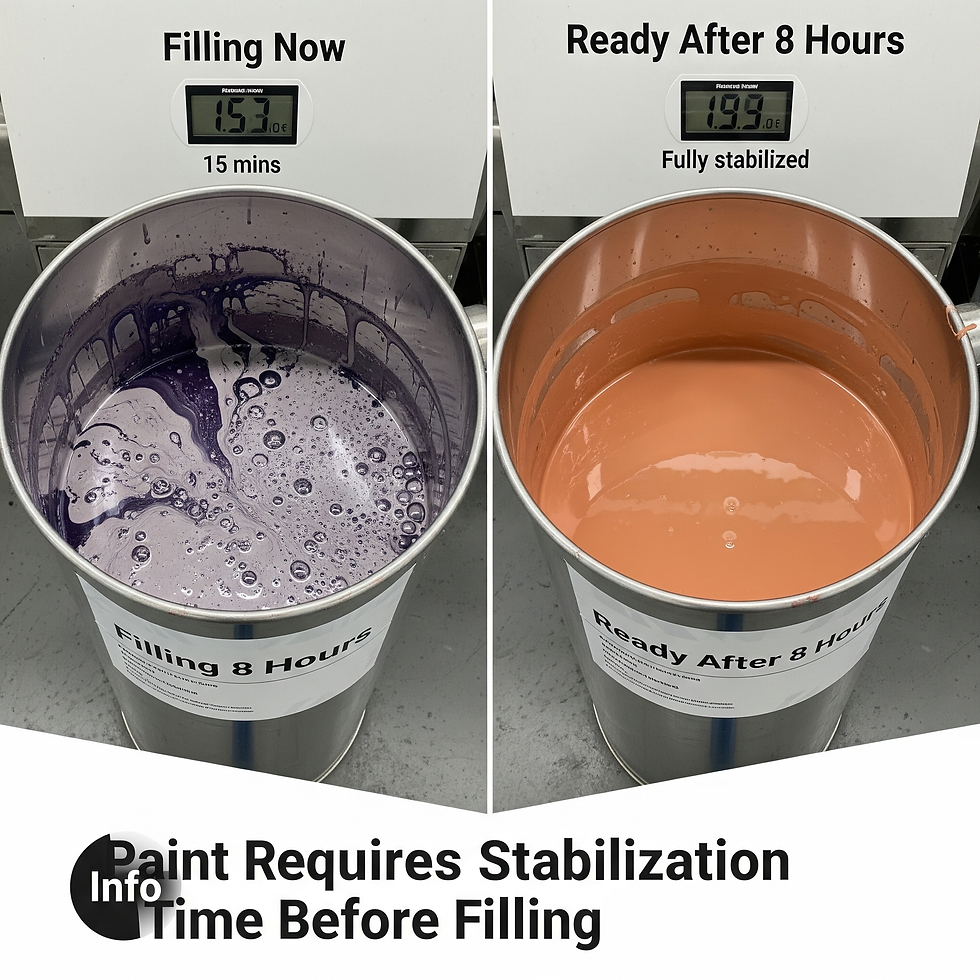
The Problem: High‑solids and pigment‑rich systems often need a rest period after dispersion and milling for rheology and micro‑bubbles to stabilize. Batches filled immediately can show air gassing, viscosity drift, or separation in drums.
Why It Costs You: Customers discover white specks, inconsistent gloss, or phase separation days later. Returns and warranty claims spike, and service teams spend hours troubleshooting remote sites.
Fix:
Define Maturation Windows: For each formula, run post‑mill viscosity and bubble retention tests at T=0, T=4 h, T=8 h, T=12 h. Lock in the shortest safe interval (e.g., 6–8 hours) before fill.
Controlled Maturation Tanks: Use dedicated, lightly agitated holding tanks equipped with gentle stirrers and nitrogen blankets to suppress oxidation or skin formation.
Batch Labeling & FIFO: Clearly label batch age and time-in‑tank. Follow strict FIFO, never pull a premature batch.
10. Manual Filling = Inconsistent Net Weight and Dealer Complaints
The Problem: Manual valves and visual judging yield fill weights that bounce around ±3–5% of the target. Underfilled cans provoke compliance issues and customer ire; overfilled ones waste paint and shrink your margin.
Why It Costs You: Regulatory fines for underfills, higher shipping costs for overweight cans, plus incessant “call‑backs” from distributors demanding credits or replacements.

Fix:
Semi‑Automated, Weight‑Based Fillers: Invest in servo‑controlled filling machines with load‑cell feedback. The filler automatically stops when the target net weight is reached. Repeatable to ±0.5% accuracy.
Air‑Assist & Anti‑Foam Modules: For foamy systems (e.g., high‑solids epoxies), integrate low‑pressure air pulses to collapse bubbles at the nozzle tip, and add a post‑fill vacuum chamber to remove headspace volatiles.
Calibrated Measuring Vessels: If filling machines are not in the budget, instead of guessing, use stainless‑steel buckets or graduated pails marked at exact volume increments. Train operators to fill to the mark, then transfer directly into cans. A Rs.12-15000 digital scale under the bucket confirms net weight within ±1%.
Conclusion: Operational Discipline = Market Trust
These ten pitfalls account for roughly 80% of batch failures, rework costs, and customer complaints across paint plants of every scale. The secret isn’t always using expensive raw materials or exotic additives, it’s rigorous process control, data‑driven SOPs, and a culture that views every batch as a live, high‑stakes experiment.
Implementing these fixes such as precise charging sequences, matched dispersion equipment, tight pigment screening, exact additive timing, optimized milling, climate compensation, uncompromising QC, flawless cleaning, proper maturation, and automated filling, will transform your plant from a reactive scramble into a well‑oiled precision operation.
Operational discipline doesn’t just eliminate waste; it builds consistency, fuels customer loyalty, and elevates your brand above competitors who treat paint as just another commodity. Start by auditing your top three pain points today, and watch your yield, quality, and profit margins climb.
📥 Download Free Resource
Paint Production Daily QC Checklist – PDF (Avanti Format)


Comments